Saudi Arabia's largest oil processing facility is taken offline because of a drone attack. A missile from an unknown source strikes an Iranian tanker causing an oil spill. Turkey invades northern Syria. These are just some of the Middle East headlines from the past month. What they indicate is a very important region of the world fraught with insecurity and escalating chaos. It comes at a time when Saudi Aramco is about to launch the largest IPO in history. It all reads like the grand plot of a Tom Clancy thriller.
Saudi Aramco announced today it will postpone its upcoming IPO. What could be the problem? It isn't difficult to think of many scenarios. The result of a prolonged war is one. As a fiction writer, I thought of another. What if Iran or Russian buys up all the stock?
Friday, October 18, 2019

Friday, October 4, 2019
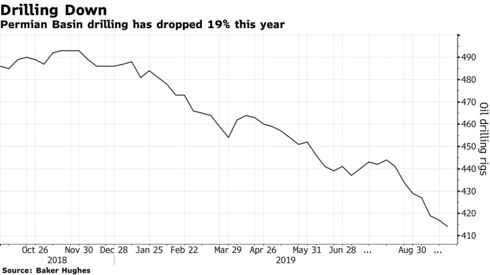
Shale Jobs are Drying Up in the Permian Basin
Barry Marks can hear the Permian Basin slowing down.
It’s right there on country-music station 96.1 FM in Odessa, Texas, where commercials for shale-patch jobs used to fill the airways. Those kinds of radio ads have fallen by two-thirds, said Marks, the general manager for ICA Broadcasting LLC, which runs five stations in the area.
“A lot of those people working in the Permian Basin do not reside here,” Marks said. “So they’re heading home every two weeks. And they may just be staying home.”
Continue reading on Bloomberg
Thursday, October 3, 2019
Should Markets Worry About Falling Saudi Oil Inventories?
Bloomberg is reporting that Saudi Aramco has restored oil production levels at the crude-processing plants at Abqaiq and at the Khurais oil field. Multiple reports that Saudi’s production would be back online quickly have helped push oil prices back down to where they were prior to the September 14 attacks.
Article continues here
Article continues here
Wednesday, October 2, 2019
U.S. shale oil boom ends as lower prices take toll
LONDON, Oct 1 (Reuters) - U.S. oil production growth is decelerating gradually in response to lower prices, which should reduce predicted over-supply in 2020 and force the global oil market back towards balance.
Read the entire article here
Read the entire article here
US Shale Production Is Set For A Steep Decline
U.S. oil production fell in July, another worrying sign for the shale industry.
The latest EIA data shows that oil output fell sharply in July, dipping by 276,000 barrels per day. The decrease can be chalked up to outages related to a hurricane that forced oil companies to temporarily idle operations in the Gulf of Mexico. Offshore Gulf of Mexico production plunged by 332,000 bpd in July.
Read the entire article here
The latest EIA data shows that oil output fell sharply in July, dipping by 276,000 barrels per day. The decrease can be chalked up to outages related to a hurricane that forced oil companies to temporarily idle operations in the Gulf of Mexico. Offshore Gulf of Mexico production plunged by 332,000 bpd in July.
Thursday, September 26, 2019
OIL REVERSES LOSS AS U.S. SENDS MISSILE, TROOPS TO SAUDI ARABIA
(Bloomberg) -- Oil reversed declines after the U.S. announced it would send air defense systems and troops to Saudi Arabia following attacks on the country’s oil production facilities that shut half of its output.
Read the entire article here
Read the entire article here
Monday, September 23, 2019
REAL CRUNCH FROM SAUDI ARABIA'S OIL OUTAGE HAS YET TO BE FELT
While Saudi Aramco is optimistic about when it's full production capacity will be restored, questions remain about the viability of their optimism.
Read the complete article at Reuters
Read the complete article at Reuters
Sunday, September 22, 2019
THE PROBLEM WITH IRAN
The U.S. and most of the world believe the drone and Cruise
missile attack on the largest oil facility in the world was conducted by Iran.
Despite abundant saber-rattling, Saudi Arabia and the United States are left with few options in
which to retaliate. President Trump has put new sanctions on Iran but it is
hard to imagine that they will inflict any more pain than the sanctions already in place. What’s stopping the U.S. from declaring all-out war against the Iranians?
A simple analogy explains the situation. The U.S. is like a
man in the desert with a rattlesnake wrapped around his leg. He has a bullet in
his pistol and he can surely kill the snake, but not without the risk of injuring himself in the process. What is the risk of attacking Iran? A chaotic disruption in the
oil market which could propel the world economy into a dangerous downward economic
spiral.
The stakes are high and the U.S. doesn't want to shoot itself in the foot.
Thursday, September 19, 2019
OIL PRICE PREDICTION - SEPTEMBER 20 THROUGH 27
By now, everyone knows the world's largest oil facility at Abqaiq in Saudi Arabia was damaged by a drone and Cruise missile attack. The Saudi's second-largest oilfield, Khurais, was also attacked and damaged. The oil markets responded by sending the price of Brent crude over $70/barrel and W.T.I. over $65/barrel. This knee-jerk reaction didn't last long and the price of Brent and W.T.I. declined the following day. At the time of this post, W.T.I. is at $58.79 per barrel and Brent is $64.93 per barrel.
Before the attack, there was little or no margin built into the price of oil to allow for chaotic global disruption. This past weekend's drone and Cruise missile attack have changed all that. The new floor for W.T.I. is $58 per barrel and $64 per barrel for Brent. Traders going below this floor should do so with caution.
So how has the attack impacted production?
1) 5.7 million barrels of production per day was taken offline
2) 2.0 million barrels of production per day has been restored
The Saudis are working diligently to restore the remaining 3.7 million barrels of production and believe they can do so by November. For the week ending September 27, the almost 30 million barrel shortfall will likely go unnoticed because the Saudis will draw down their storage to fulfill their contracts. Barring further chaotic events, the shortfall for the week will likely go unnoticed.
MY PREDICTION:
The price of oil will rise, but not by much. Closing price on September 27 -
W.T.I. - $61.23
Brent - $68.75
This is just a prediction
Tuesday, September 17, 2019
HOW DO YOU MAKE A PROFIT DRILLING HORIZONTAL WELLS?
How do you make a
profit drilling horizontal wells? It all begins with a guess. What will the
average price for a barrel of oil be during the drilling and first few seminal years
of production? Sound easy? It’s not. Just ask any of the 196 North American oil
companies that have filed for bankruptcy since 2015. The price of West Texas Intermediate
crude is anything but stable and has fluctuated more than $70 per barrel since 2014. Betting what the
price of oil will be six months from now is like playing Russian roulette with
two bullets loaded. You can employ the best statistical information at hand,
and it still comes down to a wild-ass-guess.
Say you decide that oil
prices will average $50 per barrel for the
next three years. If the horizontal well you are drilling, including land,
taxes, royalties and operating overhead, costs $6,000,000 then the well must produce 120,000 barrels of oil to get your money back. If
you factor in the time value of money, even this is a net loss. The well must
produce 240,000 barrels of oil to double
your investment. In many horizontal plays, this is an unlikely scenario. What
horizontal drillers have learned is the subsurface isn’t homogeneous, and a
very good horizontal well can easily be offset by one that is marginally
productive, or worse.
Horizontal drilling was
once called a resource play because the technology supposedly eliminated dry
holes. Since all horizontal wells aren’t created equal, the premise of a
resource play failed to take into account non-commercial producers and mechanical
failures, both of which equate to costly mistakes. The result is 9 out of 10 horizontal drillers
are cash flow negative. Put another way North American horizontal well drillers
have totaled 200
billion dollars in negative cash flow.
What is occurring now
in the oil patch is the mid-majors have lost, or are rapidly losing their
sources of funding. Horizontal wells have a decline rate of around 70%. Without continuous drilling, our 12.5 million barrels of oil per day will begin
declining rapidly, as will our dream of energy independence.
None of this is news to those actively drilling
for oil in North America. To make a profit and ensure economic growth, the stable
price of oil needs to be $75 to $85 per barrel. Anything less is a lie. The
scenario begs the question, how do you make a profit drilling horizontal wells
at an average price of $50 per barrel? The short answer is you don’t.
Subscribe to:
Posts (Atom)